Read the adsorption table with the missing geometries in view
Open the CMR record and source publication, inspect the four methods, metal surfaces, adsorption definition, and any supplied structures or supporting information. Compare methods only when site, coverage, slab, molecular reference, and sign convention match; view the final adsorption geometries if they are available. Use structure and data sources, visual tools, and literature sources.
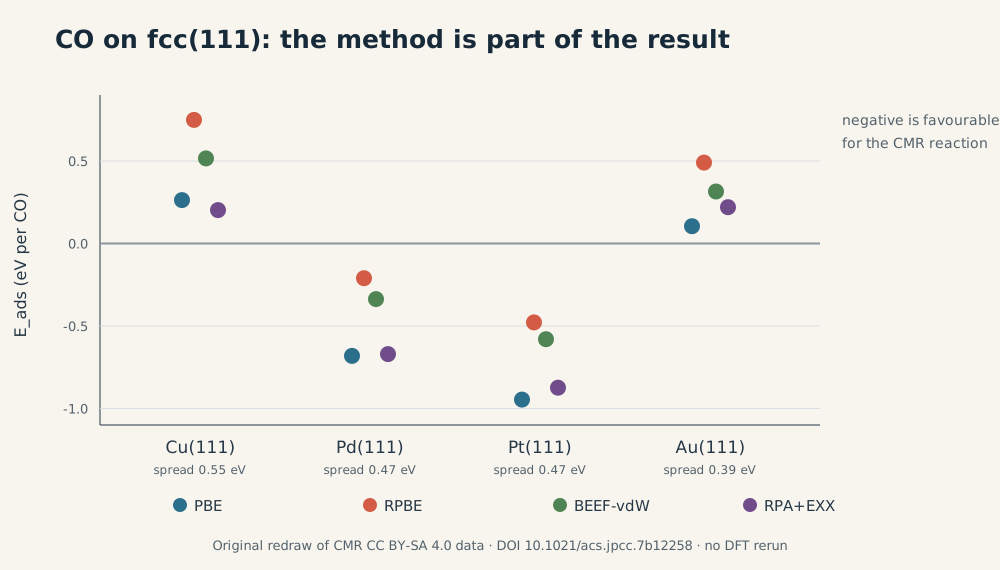
Inspect an attributed comparison: the companion script redraws a frozen, hash-bound public dataset. Read the row identities, reaction, site, coverage, and method labels before the spread; the command supplies no atomistic geometries and does not rerun the calculations.
Rebuild the attributed plot from the frozen snapshot:
python3 examples/practical-guides/cmr_co_adsorption.py \
  --svg public/media/practical-guides/adsorption-energies/replot-cmr-co-adsorption/cmr-co-adsorption.svg
The command hashes the exact JSON bytes, checks the DOI, licence, source database hash, row IDs, metal order, selected PBE values, and sign pattern, then writes the SVG. It does not run PBE, RPBE, BEEF-vdW, exact-exchange, or RPA calculations.
Claim boundary
The CMR project page documents 200 reaction records, their schema, reference reactions, and broad calculation setup. The source ASE database was downloaded on 2026-08-04 as 3,719,168 bytes with SHA-256 2ea151bbf599868fb48d615b784f8bf9c82cac94f51baf85697e1c28e025e9bf.
The snapshot preserves row IDs 109, 116, 124, and 125 for CO on Cu, Pd, Pt, and Au. It selects PBE, RPBE, BEEF-vdW, and the database’s final RPA_EXX_adsorp field without redistributing the complete database or copying the source figure.
The reaction is
with products minus reactants and negative values favourable. The broad benchmark uses full coverage and top-site adsorption on three-layer fcc(111) models under the documented relaxation construction. Those conditions define every plotted point.
The Pt row spans -0.946 eV with PBE to -0.478 eV with RPBE; all selected Pd and Pt values are negative, while all selected Cu and Au values are positive. This is descriptive method spread, not an uncertainty interval, catalytic ranking, or proof that the full-coverage top-site state is experimentally realized.
To bind the compact snapshot to a local copy of the exact public database, run:
python3 examples/practical-guides/cmr_co_adsorption.py \
  --source-db /path/to/adsorption.db
A matching byte length, hash, and selected-row comparison establish extraction integrity only. The benchmark paper remains the scientific source, and CMR records the database under CC BY-SA 4.0. Neither command independently establishes source convergence, method accuracy, low-coverage adsorption, an experimental site, catalytic activity, or a new material conclusion.