Return each plotted point to its interface definition
Read the attributed table and Methods section, identify termination, registry, layer count, cell area, separation, and sign convention for every Al/TiN row, and inspect an atomistic structure when the source provides one. Plot the values only after distinguishing per-cell adhesion or interaction energy from area-normalized interface quantities and from the stated layer-removal comparison. See visual tools, specialist interface tools, and literature sources.
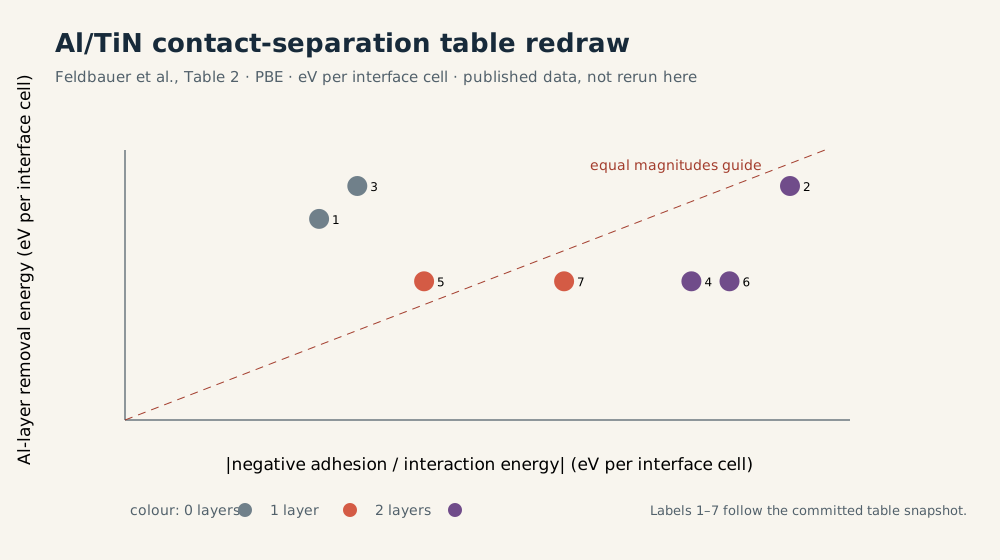
Optional attributed redraw: first read Table 2 and its Methods context in the published article or open preprint. The companion script then redraws seven frozen rows so the two per-cell axes and reported transfer labels can be compared together. It is not an interface geometry, relaxation, or independent reproduction of the calculations.
After that source check, redraw the selected rows:
python3 examples/practical-guides/al_tin_interface_adhesion.py \
  --input examples/practical-guides/data/al-tin-interface-adhesion-2015.json \
  --svg public/media/practical-guides/interface-and-heterostructure-energetics/replot-al-tin-interface-adhesion/al-tin-interface-adhesion.svg
Open the resulting plot and printed rows. Confirm that the horizontal coordinate is the magnitude of the source’s negative adhesion or interaction energy, the vertical coordinate is the Al-layer removal energy, both are per interface cell, and colour carries the reported transfer label. If any definition or row label differs from Table 2, stop the comparison. The command does not rerun the source calculations or copy the source figure.
Inspect the axes and references
The horizontal coordinate is the magnitude of the paper’s negative adhesion or interaction energy in eV per interface cell. The vertical coordinate is its Al-layer removal energy, also in eV per interface cell. Colour records the authors’ reported number of transferred Al layers after their simulated separation.
The published article and open preprint remain authoritative for geometry, orientation, termination, registry, calculation method, table definitions, and interpretation. The JSON preserves the selected row labels, units, values, access date, and no-rerun boundary.
Do not reinterpret either axis as an area-normalized work of separation, interface excess, fracture energy, or universal threshold. Such a conversion would require the exact interface area and a compatible definition of reservoirs or separated fragments. The reported transfer label is an outcome of the source’s contact-separation construction, not a kinetic barrier or general classifier.
Claim boundary
A successful command establishes transcription and rendering for seven bounded public rows. It does not establish PBE accuracy, interface convergence, cleavage kinetics, fracture toughness, an experimental contact morphology, a universal material-transfer threshold, or a prediction for another orientation, termination, registry, temperature, or material.