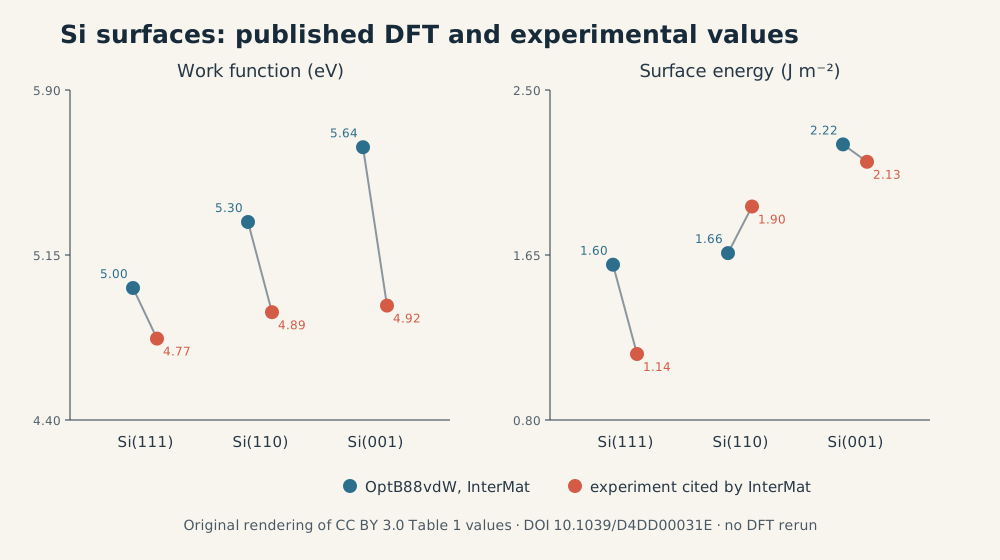
Read the public table with the facet geometry in mind
Open the attributed InterMat record or paper, inspect the stated method and facet definitions, and view representative silicon slabs when structures are available. Check facet indices, termination, unit convention, and whether experimental values are directly comparable before reading the plotted ordering. Use structure and data sources, visual tools, and literature sources to supply this context.
Inspect attributed public data: the companion script redraws a frozen, hash-bound snapshot. Check the source, facet labels, method, and units before the ordering; the command does not rerun the calculations, show slab geometries, or prove convergence beyond the source record.
Rebuild the attributed comparison directly:
python3 examples/practical-guides/intermat_si_surfaces.py \
  --svg public/media/practical-guides/surface-energy-and-work-function/compare-intermat-si-surfaces/intermat-si-surfaces.svg
The command reads the committed Table 1 snapshot, hashes its exact bytes, checks the DOI, licence, orientation order, and published calculation values, and writes the comparison. It does not run an electronic-structure code.
Inspect what the snapshot represents
The JSON identifies JVASP-1002, the source method label OptB88vdW (OPT), unreconstructed non-polar slab scope, Miller indices, units, table number, access date, DOI, and CC BY 3.0 licence. No coordinates, pseudopotentials, wavefunctions, or licensed inputs are redistributed.
For Si(111), Si(110), and Si(001), the stored calculated work functions are 5.00, 5.30, and 5.64 eV; the stored calculated surface energies are 1.60, 1.66, and 2.22 J m^-2. The plot places each beside the corresponding experimental value listed by InterMat. Inspect orientation and quantity separately; a work function and a surface energy do not share a physical denominator or convergence test.
The script reports mean absolute differences only as descriptive arithmetic for these three pairs. Before using any comparison, check whether the computational termination and reconstruction correspond to the experimental preparation. Three facets from one paper are not an error distribution or an accuracy benchmark.
Claim boundary
The NIST-hosted article PDF supplies the dataset and Table 1 context. A successful command establishes snapshot identity, selected-value transcription, arithmetic, and deterministic rendering. It does not establish DFT convergence, experimental comparability, surface reconstruction, termination stability, method accuracy, or a new conclusion about silicon.